
Wolfram – Movie Review
Warwick Thornton’s Wolfram may not possess the same tight narrative cohesion or singular dramatic momentum that made Sweet Country such a devastating triumph, but it remains a deeply affecting and visually arresting examination of Australia’s frontier past and the wounds it continues to leave upon the nation’s identity.
Structured in five chaptered segments, Wolfram plays less like a conventional Western narrative and more like a fragmented frontier elegy. It’s a series of haunting episodes stitched together by grief, displacement and survival. Set in the Northern Territory in 1932 amid the Hatches Creek wolfram (tungsten) mining boom, the film exposes a brutal and frequently overlooked chapter of Australian history, portraying Aboriginal children forcibly removed from their families and exploited as labourers in the mines.
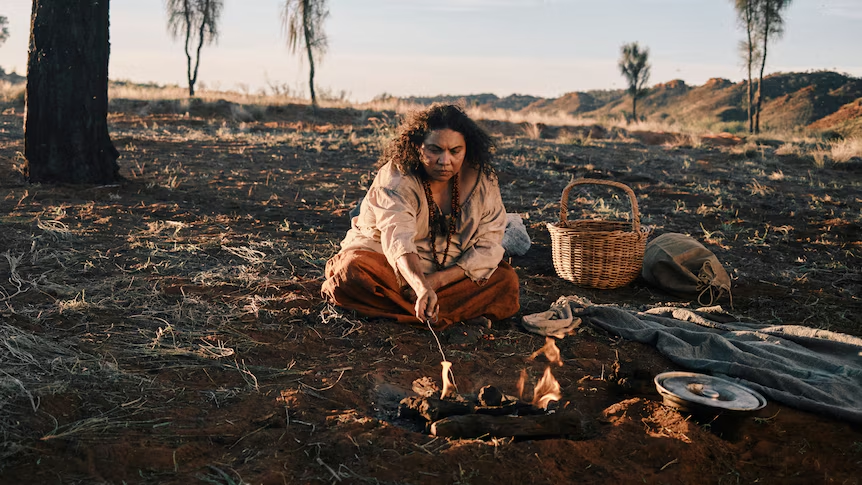
Thornton does not romanticise the outback. This is not the sunburnt Australiana of tourism campaigns or nostalgic bush mythology. The world of Wolfram is suffocatingly dusty, fly-ridden, harsh frontier landscape where colonial violence and racism permeate every interaction. Yet even amid that ugliness, Thornton consistently finds extraordinary visual beauty. His cinematography is once again among the finest of any Australian filmmaker working today, transforming barren desert horizons into painterly compositions drenched in light, shadow and silence.
The film follows two young girls, Max (Hazel May Jackson) and Kid (Eloise Hart), struggling to survive the cruelty of the mining settlement they’ve been stolen to while longing to reunite with their mother Pansy, played with aching warmth and quiet devastation by Deborah Mailman. Meanwhile, Pansy traverses the wilderness alongside her Chinese husband (Jason Chong), endlessly searching for those she was forced to leave behind, creating a parallel journey built around longing, maternal grief and endurance.
One of the film’s most compelling elements is the return of Philomac, the young boy from Sweet Country, now grown into a conflicted young man portrayed by Pedrea Jackson. His presence gives Wolfram its clearest connective tissue to Thornton’s earlier film while deepening many of its themes surrounding race, identity and exploitation.
In Sweet Country, Philomac worked on a cattle station owned by Mick Kennedy, played by Thomas M. Wright. Kennedy represents one of the harshest expressions of white settler racism and the previous film strongly implied that Philomac himself was Kennedy’s mixed-race son, exposing the deeply exploitative and unequal relationships that existed between white landowners and Aboriginal communities.
That dynamic becomes even more tragic in Wolfram. Adult Philomac is still working under Kennedy’s control, seemingly trapped within the same systems that shaped his childhood. But after encountering Max and Kid, Philomac ultimately chooses to leave with the girls, rejecting the colonial authority that has long defined his existence. In response, Kennedy joins forces with Casey (Joe Bird) and Frank (Erroll Shand) to pursue the children and recover what they effectively view as “lost labourers.” The pursuit transforms the film into a bleak frontier chase story where human beings are treated as commodities within an exploitative colonial economy.


Philomac’s internal struggle becomes one of the film’s strongest thematic threads. He attempts to navigate the impossible tension between surviving as a “blackfella” while being pressured to act like a “whitefella,” embodying the fractured identity imposed upon many Indigenous Australians under colonial rule. Pedrea Jackson gives the character a quiet sadness and emotional restraint that makes his journey particularly affecting.
Thornton’s screenplay is intentionally loose and episodic, but that looseness occasionally works against the film. Certain narrative threads feel underdeveloped, and the pacing can drift, particularly in the middle chapters where atmosphere often overtakes momentum. Characters appear and disappear abruptly, and the film sometimes feels more interested in emotional texture and symbolic imagery than dramatic clarity. Audiences expecting the tightly wound tension of Sweet Country may find Wolfram comparatively diffuse.
Yet even when the storytelling falters structurally, Thornton’s direction never loses its emotional force. The violence throughout the film is sudden, ugly and matter-of-fact, refusing the catharsis often associated with Western genre conventions. Instead, Thornton presents frontier brutality as systemic and exhausting. It’s less heroic conflict than inherited national trauma and what ultimately lingers most about Wolfram is its emotional conclusion.
Thornton’s conclusion reveals that Pansy is also the mother of Philomac, reframing the film as the story of an Indigenous family fractured by colonial systems and slowly brought back together. The final reunion, silhouetted against a breathtaking sunset horizon, lands with genuine emotional power in a moment of tenderness and healing that emerges from a film otherwise steeped in suffering.Like much of Thornton’s work,
Wolfram is interested less in conventional narrative satisfaction than in truth-telling. It confronts the legacy of forced removals, exploitation and racial violence with an honesty that feels both historical and painfully contemporary. The scars of the frontier are not presented as relics of the past, but living wounds that continue to shape Australia’s cultural identity today.
It may not reach the towering heights of Sweet Country, but Wolfram confirms once again that Warwick Thornton remains one of Australia’s most visually gifted and uncompromising cinematic voices delivering another scorching “meat pie” western that exposes the harsh frontier realities of Australia’s outback and its brutal racist realities.

Wolfram is in Australian cinemas April 30


