
Why Speed Racer (2008) is an Underappreciated Masterpiece That Was Way Ahead of Its Time
Growing up, 2008s Speed Racer wasn’t just a movie to me – it was THE movie. I was so obsessed I built a cardboard Mach 5 in my living room and pretended I was Speed, drifting around imaginary corners like my life depended on it. I didn’t want to watch him, I wanted to be him.
But while I was busy living my best Speed Racer fantasy, the rest of the world was out here calling it a flop.
They didn’t get it. Not yet.
It didn’t just crash at the box office. It was torched by critics, sidelined by audiences, and shoved into the “weird Wachowski flop” bin without a second thought. But now? I think it’s time for audiences to revisit the turbo-charged, technicolour masterpiece that dared to be different and paid the price for being too bold, too soon.
Let’s start with the elephant in the racetrack, the visuals. The film looks like a Skittles packet exploded inside a Hot Wheels playset. But guess what… THAT’S THE POINT!

The Wachowskis crafted a visual language that mimics anime in motion, using a live-action cast and entirely digital environments. This wasn’t sloppy CGI like many assumed, this was digital impressionism. The camera didn’t obey gravity, the editing didn’t obey logic, and the world didn’t obey realism. And yet, it all worked because it leaned fully into its anime roots. It’s a movie that feels like it was shot inside a Saturday morning cartoon, and that’s not a flaw. That’s design.
In 2008, I don’t think general audiences were ready. But since then we’ve had movies like Across the Spider-Verse, Scott Pilgrim, Everything Everywhere All At Once that have this heightened, stylised aesthetic. In 2025, these films are celebrated but Speed Racer was drifting around their curve before they even got on the track.
All that style would be hollow if the story didn’t hit. But this movie’s got more heart than most movies these days.
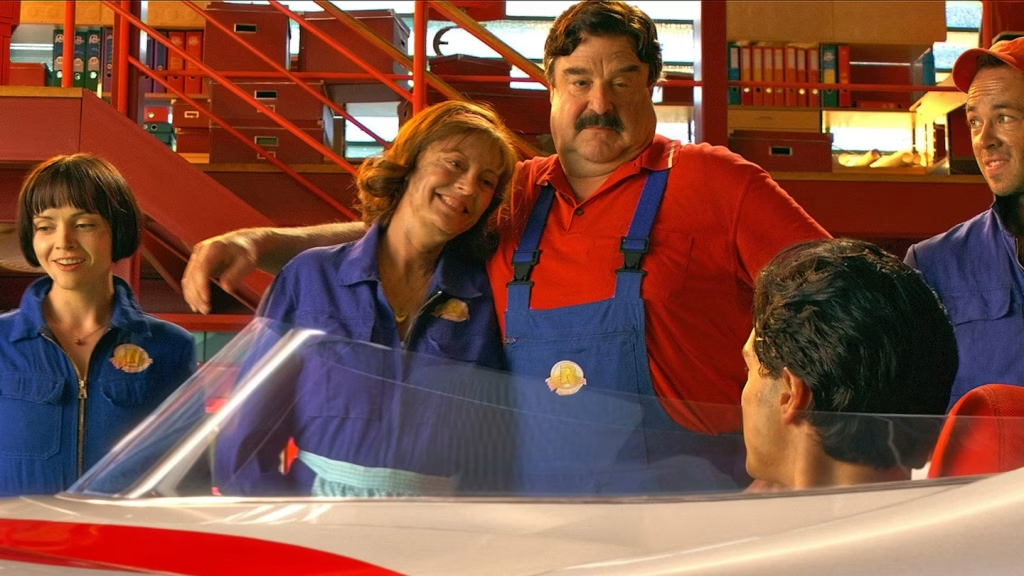
Speed Racer is a tale of family, integrity, and rebellion against soulless corporate overlords, a message that’s… uh… aged very well. The Racer family isn’t just a quirky sitcom unit. They’re the emotional engine of the movie. John Goodman and Susan Sarandon sell every moment like they’re gunning for Oscars, and Emile Hirsch plays Speed with earnest sincerity that somehow holds it all together.
And let’s talk about that final race. It’s not just a climax, it’s a symphony of motion and emotion. The way the visuals build alongside Michael Giacchino’s soaring score, culminating in the spectacular payoff that is Speed crossing the finish line. Gives me literal chills. That moment isn’t just cinematic. It’s transcendental. It’s one of the scenes I still credit to being the reason why I love cinema so much.
So why did it flop? Because Speed Racer was too weird, too vibrant, too emotionally sincere for the mid-2000s. It was released into a world that thought The Dark Knight was the blueprint for all blockbusters. Grit was in. Colour was out.
But here’s the thing about art that challenges norms, it takes time to settle into the culture. Speed Racer wasn’t a failure. It was just early. The people who wrote it off as a sugar-coated mess didn’t realise they were watching a genre-defying, future-facing film that broke every rule and stuck the landing.
Fifteen years on, Speed Racer isn’t just cult-worthy. It’s visionary. A kinetic, kaleidoscopic love letter to storytelling, filmmaking, and the audacity of going full throttle in your own direction. It’s a reminder that not all masterpieces are understood in their moment. Some just have to wait for the rest of the world to catch up.
So if you wrote it off? Rewatch it. If you’ve never seen it? Buckle in.
Because Speed Racer doesn’t just go fast… it goes hard.

Binge. play. Watch. Repeat.


